Romance, adventure, history. There is absolutely no denying that even in the present day, polo conjures up imagery that is linked to all three and more. It is the game of Kings and rightly so. From the early ages of the Book of Kings up to modern day England, our histories are rich with tales of plunder and pursuit with many a defining battle fought with Emperors or Generals on horseback. The same riders always found time to relax or play the sport. All across Asia Minor, China and the Indian sub-continent, this use of calvary swept across civilisations and strange lands, changing the fate of peoples and their history. Legend has it that to this day, somewhere along the famous Silk Route in Central Asia, lies a stone tablet beside a polo ground with the inscription:
Let others play at what they will. The King of Games is still the game of Kings.
Renowned ninth century poet of Ancient Persia, Firdausi puts it best in his numerous accounts of heroism and poetry in the epic Shahnameh, where he romanticises a match between Turanian forces and Syavoushi followers. The poet is elegant in his praise of Syavoush's skills on the polo field. Firdausi also tells of Shahpour a Sassanid king of the 4th Century AD, who learnt to play polo at seven years of age. The 9th century Persian historian, Dinvari, describes polo and its general rules and gives some instructions to players including advice such as 'polo requires a great deal of exercise', 'if the polo stick breaks during a game it is a sign of insufficiency' and 'a player should strictly avoid using strong language and should be patient and temperate' – maxims apposite perhaps even today! The 10th century Persian king Qabus also set down some general rules of polo and especially mentions the risks and dangers of the game.
The 13th century poet Nizami weaves the love story of the Sassanid king Khusrau and his beautiful consort Shirin, around her ability on the polo field, and describes matches between Khusrau, his courtiers, Shirin and her ladies-in-waiting. Nurjehan, wife of the 19th century Mughal Emperor Jahangir, was also skilled at polo. Polo was a popular royal pastime for many centuries in China, the Chinese probably having learned the game from the same Indian peoples who were taught by the Persians. The polo stick appears on royal coats of arms in China and the game was part of court life in the golden age of Chinese classical culture under Ming Hung, the Radiant Emperor, who was an enthusiastic patron of equestrian activities. Perhaps less cultured, was the reaction of Emperor Tai Tsu who in 910 AD, according to one source at least, ordered all the other players beheaded after a favourite was killed in a match.
Its more recent history, British tea planters in India first saw the game in the early 1800's. However, it was not until the 1850's that the British cavalry drew up the first rules and by the 1870's, the game was well established in England.
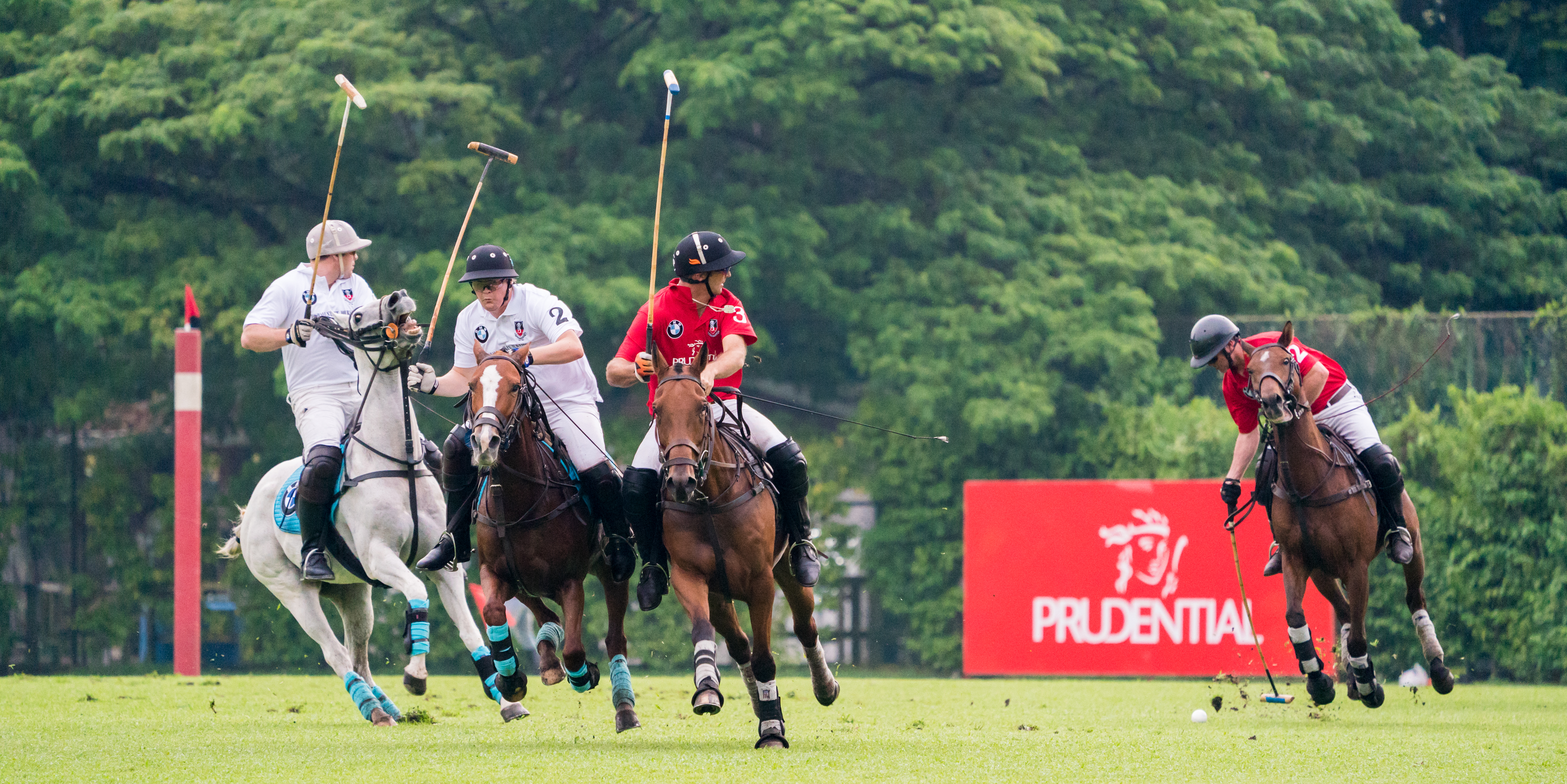
Today, polo is played around the globe, chiefly in the United Kingdom and increasingly on the continent, in Australia, both North and South America (in Argentina with its flat pampas, polo is of course almost the 'national sport' second only to football). Polo also reigns supreme in North Africa as well as the Middle and Near East, South Asia (notably India and Pakistan) as well as South-east Asia (Malaysia, Singapore, Thailand, the Philipines and Indonesia).